

HOW ANIMALS SHAPE THE WORLD WE LIVE IN?
The animals are intelligent, brave and engaged to contribute to the Planet Earth. Their activities are not only the part of the evolution in fauna but also the necessary components of the daily rhythm in nature. Each of them has significant role in molding the wild habitat, preventing some negative outcome or enhancing the positive effects. So, yes, when we see some animals doing some odd things, we must understand what all is behind. Our little fellows know more than we think they do.
One of the most awesome engineering arts are the one that are done by beavers. They are very well known as skilled architects and their lodges and dams are worth of admiration. Those creatures are organizing the river systems, fight against erosion, set up their still ponds and winter shelters as well as underground dams. Their woodwork could be used as exceptional case study for people´s wood engineering and site activity. The last example of Czech Republic has shown that 8 beavers and their engagement saved almost one million of government funds for dams, by handling it themselves. This is not the only one remarkable action. Just to think of the largest beaver dam in Canada, in Wood Buffalo National Park, that could be seen even from space, reaching the length of 7 stadiums.
The beavers are also very talented for weatherproofing and preparation by all available means for the coming seasons.
Next impressive animals are, with no doubt, the bees with their internal hierarchy and smart architectural occupation. According to Thomas Hales, the U.S. mathematician, the bees have the most efficient structure in the nature: „The equation is called The Honeycomb Conjecture and states that ´regular hexagons provide the least-perimeter way to enclose infinitely many unit areas in the plane. ´
Basically, bees have figured out the best way to separate the surface of their hives in equal parts all around using the least possible total perimeter thus reaching 100% efficiency in design. “

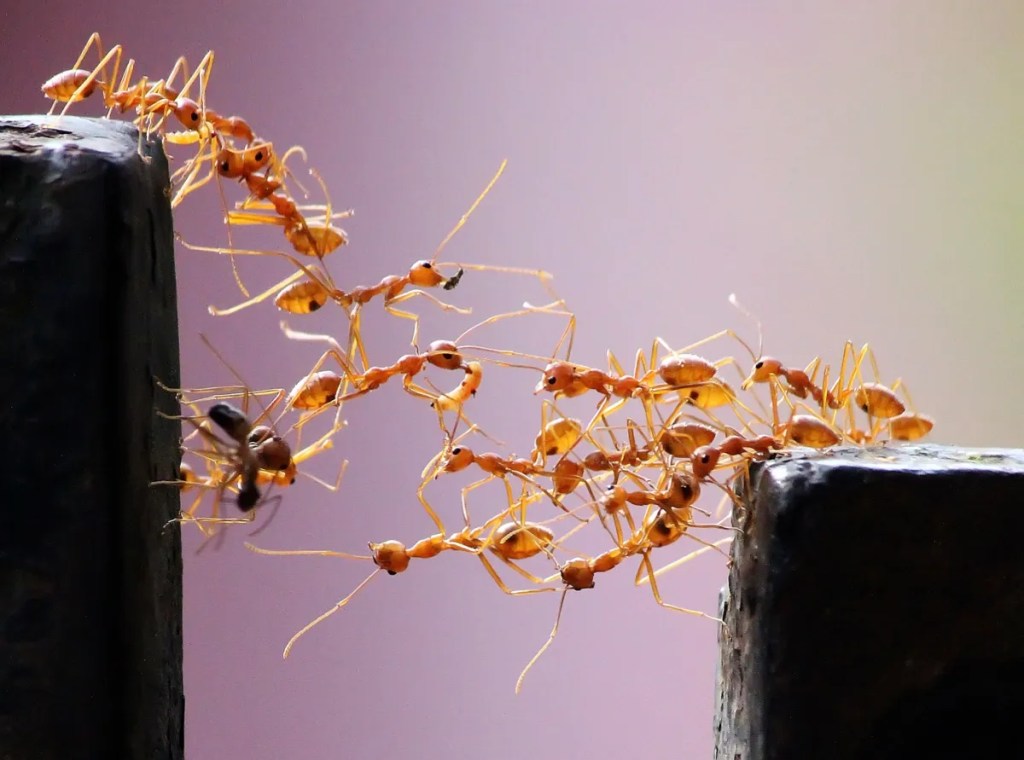
What about ants? I am sure you asked yourself if the ant colony will be also on the list. Indeed. Those insects can build, in a week, the equivalent of skyscraper in ants’ universe. If we could imagine, you shall know that we took 13 months for the Empire State Building to be done. Ants could have it done in one week. They are great system workers, empowered by united team performance, shaping fascinating underground galleries and tunnels. It is interesting to know that they categorized rooms, so the one room is for stored food and processing by fungi, the another for wasted items, the third for relax. The scientist discovered 6000 km long underground ant nest (back in 2002) from Spain to Italy, via France and Portugal.
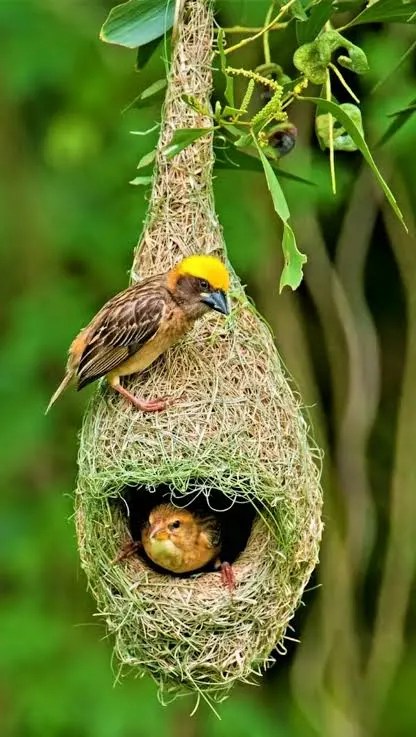
Have you heard about the weaver? Those African birds are known for fine work with nests. They use different materials to build lofted block of nests that could accept the whole colony of birds at time, about 400 birds. Each chamber or nest is separated with fine grass in between and they also have security system of its own kind. They put sharp straw spikes on each entrance to keep away predators. Their nest building is used by another lazy birds that set up their nest on the top and use it as safe foundation.

Then, the spider and its famous web. Personally, I find each web unique and authentic, but the Australian leaf-curling spider uses recycled material to build an additional home. The small creature is using a nice dead leaf that lines with silk, curling it to make a super cool shelter or rather called retreat, some kind of lounge. This is somehow the main room for chilling while they are waiting for food, and it is located in the middle of web. When female is expecting her babies, will invest in making nursery leaf that will be separated and protected. Sometimes they even use old paper to make those cool vibes zones.
There are many great workers and contributors in fauna world, that are hardworking mold our ecosystem and planet. They do work but they do not ruin, accepting the borders of nature and mutual cohabitation. It is so sad that we, as human race, as intelligent race, are not able to learn to harmonize with other fellows. I am always asking myself why is that so complicated? We can all live happily after, and it wouldn’t be some fairytale. It is enough for all if we don’t let our greed commands us and ruin all perspectives.

The animals are perfect residents, tolerant neighbors and good partners in crime. They are living their life without judging us for being everything but not responsible. If there is a wish from my side, then it is a return of common sense to humans, so we can protect the treasure we have: animals and nature. That’s all I want and need, and I believe that this would save us from many other problems and issues. There where we find peace, there we will stay.

We can learn so much from animals and implement in our egocentric world. That’s the only hope that we can save something valuable for future generations, without showing them that we failed as species that never managed to be compassionate.


Sarah’s thought provoking and informative article reminded me of the ongoing debate among ecologists about niche construction…
Niche construction is the ecological process by which an organism alters its own respective, natural environment (e.g. building of nests and burrows, the creation of shade, the influencing of wind speed and nutrient cycles in plants), which encompasses body waste (e.g. urine, feces), as well.
There are multiple factors influencing DNA development in organisms (e.g. genetic imprints, climate, topography, diet, oxygen and water quality), and niche construction is in synchronicity with natural selection, ostensibly: ecological inheritance refers to the inherited resources and conditions, and associated modified selection pressures, that ancestral organisms bequeath to their descendants, as a direct result of their niche construction.
Arguably, organisms do not passively-adapt through selection to pre-existing conditions, but actively-construct important components of their respective niches.
In 1988, English biologist Dr John Odling-Smee was the first to coin the term ‘niche construction’, and the first to make the argument that niche construction and ecological inheritance should be recognised as evolutionary processes.
In the context of Homo sapiens, the species has engaged in extensive environmental modification through cultural practices. Such cultural practices are typically not themselves biological adaption, but rather, they are the adaptive product of those much more general adaptations; such as the ability to learn, particularly from others, to teach, to use language, etc., that underlie human cultures.
LikeLike
Your work’s are amazing.
LikeLike
Thank you ! 😍
LikeLike