

THE MOST DANGEROUS BIRD IN ALL ITS BLUE BEAUTY
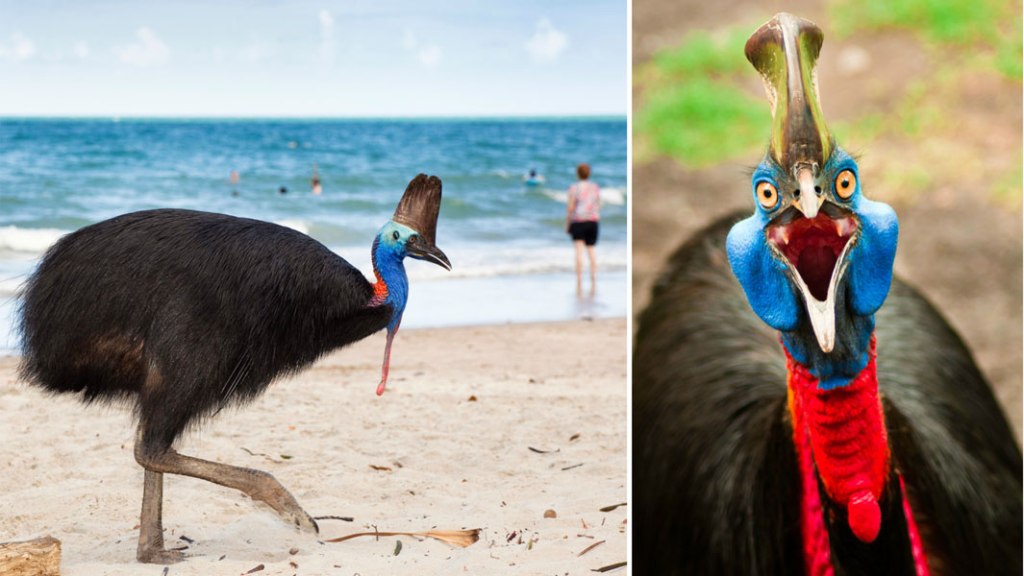
I have never been to Australia but that is on the top of my own Buckets list. I admit mostly because of precious animals and breathtaking nature. The mystical wetlands and hidden mangroves, the crawling and poisonous creatures but also the teddy-bears with big smiles. Love the whole package, already. Somewhere in between, I learnt about the modern dinosaur bird of Australia. Yes, the cassowary is almost like a mythological fellow that still attracts lots of interests, admiration, fear and respect.

The bird looks like some exotic mixture of old turkey and an ostrich, but it is still unique and like taken out from some Narnia universe. With weight up to 60 kg and height up to 1,8 meter, the cassowary also has a horn on the head that could reach 18 cm. The scientists aren’t sure what is the role of this authentic mark, maybe to attract opposite sex, to keep away enemies or simply to be good looking animal.
Our modern dinosaur is the world´s most dangerous bird because of its claws on the middle finger that could be 12 cm long. The long legs are helping in kick off activity so we can simply imagine them as kick box and kung fu specialist. So, if happens that you meet this warrior and provoke, you might end up injured and even killed.
Not anyone can encounter this flightless bird that is known to roam in the tropical parts of North Queensland. They are rainforest gardeners, that love fruits. They are almost obsessed with fruits and some fruits got the name in honor of birds: Cassowary Plum and Cassowary Stain Ash:” This passion for fruit leads the cassowary to perform a very important duty. After eating fruit whole, their digestive system is gentle enough to keep the seeds intact. As the Cassowary roams the rainforest, they disperse the seeds (use your imagination) into a new area of the rainforest in their own special fertilizer formula.”
So, beside their ecological work and awareness, those birds are sharing the heritage with powerful Jurassic fauna. With their features, they remind us on the ancient world and amazing creatures that used to live on the Earth.

Those shy, tropical residents and fruit lovers are very solitary and appreciate solitude all the time, except in the mating season. From May to November, the cassowary is open to new relationships and interested in fascinating and choosing the right partner. When the lady finds Mr. Right One and laid her eggs, she is leaving the nest, and the dad is overtaking the care of the new generations. This means also that he is building the nests and incubates the eggs for 50 days, fasting almost all the time. The young birds will stay with their dad for about 9 months and will learn about survival skills. After this period, those cute birds and romantic offsiders, will leave the dad´s place and search for their own. So, this is the time when usually could be the encountering between father bird and predators or even humans and that must be prevented. The bird won’t hesitate to defend its nest and family. Even if the contact is somehow done, please make sure to avoid the animal or change the route. These creatures are elusive and exclusive, so I am pretty much sure it is not easy to see them, spot them or even be close to them. Nevertheless, it is still an option that you might cross the paths with them during the exploring of nature and be sure to get out of direct triggering.

Even their name Casuarius has the background in Papuan words: kasu – horned and weri – head. That’s all about their look and casque that they are wearing like a crown. This horn structure form is made of keratin, and it is still discussable. The ornithologists come out that it could be considered as way of communication but also as tool for temperature regulation.

We shall make a difference among three species of this bird: 1. Southern cassowary which is the largest of all, mostly located in northeastern regions of Australia. 2. Norther cassowary that has only one wattle and lives in northern corners of New Guinea´s coastal lands. 3. Dwarf cassowary : Bennett´s cassowary and known to be in Yapen Island and New Britain.
Unfortunately, this bird is also in decline due to the natural habitat loss and human hunt. The locals usually hunt them for meat and nice feathers. That is used for traditional outfits and local cults. Their bones are taken for making working accessory while their horns and claws are placed for the purpose of arrowhead. The dinosaur bird is not just like that in the Guiness Record Book but as the deadliest bird on the Earth. It wont surrender without fight which not always mean that the human will win. Beside it, cassowary is a perfect runner, and it can develop the speed till 50 km/h.

Some people in Australia consider the bird as murder bird but I would say that if you don’t provoke it, you don’t have to be worried. As always, animals need their place to be in peace with themselves and nature and without humans. We need to learn how to respect harmony and balance in the ecosystem, without always trying to push our rules, our ideas and our superiority. The humans are far away from ideal Earthlings, so dominated by own ego and narcistic nature, forcing anthropocentric life settings. The Plnet is home for all, not only for homo sapiens. Instead of sharing about our superior role on this world, we shall share the education, compassion, and dedication to support wildlife and save our Earth, since we don’t have any other home.
Leave animals alone.


Sarah’s informative and delightful article induced me to recall to mind the ongoing scientific debate of cassowary early-evolution…
The casuariiform fossil record is ambiguous, and the present knowledge of their genome is insufficient for comprehensive analysis.
Ostensibly, cassowaries diverged from a common ancestor with emus around 25 to 30 million years ago. The earliest known ratites, which include cassowaries, date back to The Paleocene Epoch, about 56 million years ago: birds first appeared on Earth in The Jurassic Period c. 150 million years ago.
The ratites are thought to have evolved from a common ancestor that lived in Gondwana. As the supercontinent Gondwana broke apart, plate tectonics carried the ratites to their current locations.
In all probability, the cassowaries are related to the kiwis of New Zealand; both families diverging from a common ancestor about 40 million years ago. The cassowary’s closest living relative is the emu.
There are fewer than 4,600 cassowaries left in the wild. They play a vital role in rainforest ecology and regeneration by dispersing seeds through their droppings…
LikeLike