

THE MANUL DOESNT ALLOW TO BE SEEN
I am sure you have seen them on the photos, how beautiful they are. Those wild cats with mesmerizing eyes and adorable paws are definitely one of a kind. They have short legs and dense fur so they can be adapted to the harsh environment.

Pallas’s cat (Otocolobus manul) is a small wild cat that has a flat forehead, stocky body and cute and authentic face because of the wide cheeks and fluffy ears. It is known that they are located in the grasslands and steppes of Central Asia, which means they could be found in Eastern Mongolia, western parts of Iran and throughout the China. Their grey fur is usually so colored for the winter months while they do get reddish tone in the summer period of year. The fur is so designed to help them find perfect camouflage and to avoid potential enemies.

The manuls arent not only photogenic but very elusive and inteligent feline. Their diet is based on small mammals but they do also prey on lizards and birds, sometimes on small wild sheep. It depends on accessibility on the range. When they are hunting, they do that during dusk and dawn, to be able to escape the predators like foxes and eagles:”Pallas’s cats have astoundingly large home ranges for their size, with one male recorded as having a territory of up to 207 square kilometers (129 square miles). A male’s territory can overlap with up to four females, and Pallas’s cats have been known to migrate territories in the months when they may be at risk from predation. “

Those awesome creatures have got their name when Peter Simon Pallas, the German explorer described them for science, back in 1776. Those rock wild cats are known to be hidden and not so exposed so it is really a challenge to find them and see them. The female has only 2-3 kittens per year and majority of them dont survive since there are all over the raptors. This put the manuls among “Near Threatened” on the IUCN Red List because of the descreasing population. The main problem is hunting in Mongolia where those alluring fellows have been killed for their pelt. Just to remind that hunting in Mongolia is allowed. As always, humans make it worse, destroying all what is given to us on this Planet. Not to mention, that there are still many traps for foxes and wolves and sometimes these cats are also the victims of it. The local farmers try to protect their livestock killing all what is around, forgeting as well that the habitat is not only made for homo sapiens.

It is interesting to note that they appear very big due to their specific look but actually they are the size of bigger domestic cat. As soon as their mating season is ended ( it lasts between 26-42 hours) they are going nack to their solitary and lonely life that they perform. The both males and females mark their territories and try to find shelter when it is outside the hunting time. It is mostly in the caves and shaped rock formations, the homes made by other animals but used by manuls that seek for comfort. Those animals are bad runners that rather escape the conflict, hidding themselves underground,
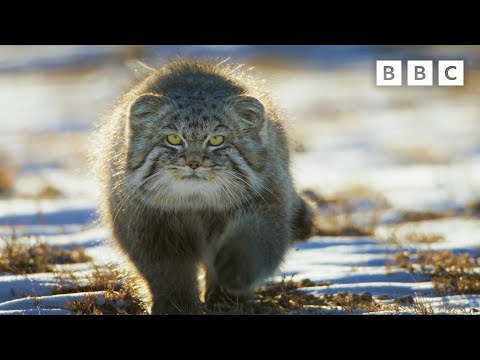
They have very expressive faces and sometimes are even names as grumpy wild cats. The cuteness comes from flat ears but the story is deeper and have something to do with their survival skills, according to Jim Sanderson, Ph.D.:“Winter in the Asian steppe especially at high latitudes in Mongolia and north into Russia and the windswept grasslands of Kazakhstan, can be brutally cold. Large ears like those of a jackrabbit give off a lot of body heat, an advantage in the hot desert like the Sonoran desert but a disadvantage in cold places. (Having) no ears would be best, but Pallas’s cats must also listen for rodents, so they need ears. Evolution has produced the perfect compromise.”
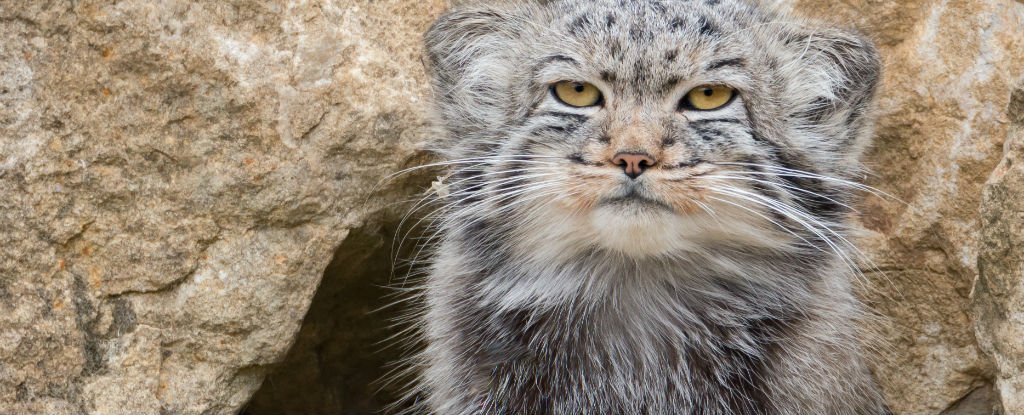
Many people would like to have them as pets but they are wild animals and they should remain wild animals, enjoying their freedom. Those creatures are adapted to the life in special environment and all what would be outside the known range, would be a disaster for their health. There is a ground for their look and their character. The nature has taken care of everything and taking those felines away from their known habitat would be an act against widllfie and freedom of animals . These cats are not domesticated and shouldnt be, even through is that pretty much possible. They are proud loners that need their rhytm of life, that is not guaranteed to be established by us, humans.
The tragedy is that those wonderful animals being mostly killed in the winter time. Their meat is used as well as fur for coats, hats and gloves. Beside it, their fat is also highly appreciated in Mongolian gastronomy. The conservationists work hard on searching for cohabitation tools and options to protect them within the growing human population and demand on the territory that once was manul´s.

There is only a hope that we wont be too late to save them for future generations and let them play significant role in grassland region of Asia. They have a crucial contribution in the food chain and in the global ecosystem and once when this is out of balance, everything will be changed, as always. We really need to keep on learning lesson to be responsible rezident of the Planet. Unfortunately, we dont have much time since the mankind has already ruined all what was ever possible to be ruined. We need to stop now and to embrace the harmony with other creatures before we are not wipped out like the failure of the universe.


 SARAH MAX RESEARCH
Sarah’s delightful and informative article induced me to ponder what the natural topography was like, when the Prussian expedition team ventured into the region (1768-74) where the Pallas’s cat was first documented by the scientist Dr Peter Simon Pallas (1741-1811)…
Lake Baikal in Siberia is where the expedition team ventured to its furthermost destination and this is where the team observed the Pallas’s cat individuals and families. The team was researching in all seasons and documented the cat species in different seasons.
Dr Peter Simon Pallas was invited to Saint Petersburg by Queen Catherine II of Russia; a fellow Prussian. She was investing in efforts to evolve Russian tertiary and research institutions by offering academic posts to prestigious Western European scientists, etc. The expedition of 1768-74 was a joint Russian-Prussian endeavour and its research significantly-advanced knowledge of flora and fauna of central Russia; aside geographical, geological and meteorological data.
Lake Baikal is a large rift lake in Siberia that emerged c. 30 million years ago. In the 1770s, it was extremely-pristine (i.e. freshwater quality, marine biodiversity). The Pallas’s cats were existing along its shores and upon slopes of the surrounding mountains and ranges intrinsic to The Taiga forest. There was no real urban or industrial development there, then, and so no synthetic pollution.
With more than 1,000 species of flora and 3,000 animal and insect species (80% endemic), the Pallas’s cats had abundant food and water resources, then; gaining weight in autumn to survive the harsh Siberian winters. They were and are carnivorous and hunted by ambush tactics such species as lemmings, marmots and hamsters, as well as small birds and mountains hares.
The lake and surrounding environment are greatly changed now (e.g. toxic pollution during Soviet period and recent decades) and as Sarah mentioned in her article, the Pallas’s cat is under threat from the impacts of human activities…
LikeLike