
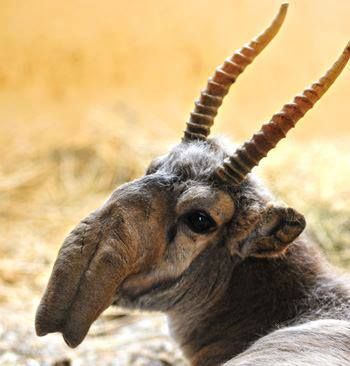
THE UNIQUE ANIMALS THAT ARE ALMOST GONE IN CENTRAL ASIA AND LOOK LIKE ALF

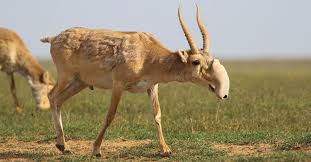
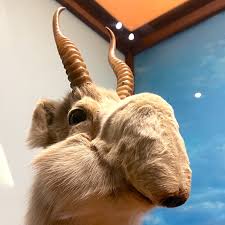
When I saw their photo in some of numerous edition of National Geographic, I got pretty much curious. These animals have everything but not standard beauty and the scientists like to claim that they are on the Earth for almost so long that they even saw mammoths. The good question is where they could be found now when they are almost extinct in big part of the Eurasian lands. The antelope with bulbous nose and specific look have been known to like grasslands of Kazakhstan, Mongolia and the Russian Federation, Turkmenistan, and Uzbekistan. The area with open dry steppe and semi-arid deserts is very attractive habitat for those migratory herbivore. If you take a look on them, you will be astonished with their over-sized nose that has a very flexible structure and the function of filter. In the summer time, their nose filters out the dust accumulated from the herd movement while during the winter, warms up the cold air before it goes into the lungs. So, yes, saiga antelope have their own saga of life survival, under all conditions. The migratory policy that they follow could be understood through the fact that they gather the groups for the breeding, in spring time and in the fall, they organise their journey for the winter shelter. Sometimes, those road adventures up to 1000 km long.
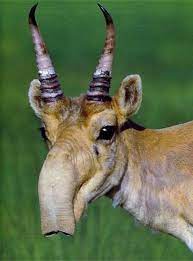
It is devastating to note that hunting of saiga antelope is active for centuries. The problem is that their skin and meat is very popular and even Kazakhstan export the meat annually. It is said that their meat is similar to lamb meat and has a big importance in the Central Asia cuisine. That is not the only issue with those beautiful mammals since they are also targeted by poachers and play a role in the illegal wildlife market, especially since the rhino horn is officially banned and controlled in the trade. Again here, as always, we have some fake medicine from China that believe that horn from saiga animals (comu antelopis) have a superpower in different part of human life, used as elixir, cosmetic or even as the stimulation of sexual drives:“The Memorandum of Understanding (MoU) Concerning Conservation, Restoration and Sustainable Use of the Saiga Antelope was concluded and put into effect in September 2006. It was under the auspices of the Convention on Migratory Species of Wild Animals (the Bonn Convention). The decline in the saiga antelope population has been identified as one of the fastest population collapses of large mammals in recent memory. The MoU was developed to assist in reducing the exploitation of the animal and to restore its population in Central Asia.”
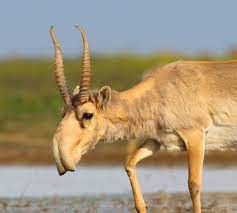
If we go back to the history of the mankind, we can witness the development of the human colonies from Carpathian Mountains, over western Ukraine to China and also the disappering of those elegant antelope from those areas. They are one of the rare mammals that crossed over the mammoths, many years ago and survived until now. After the human attack on them, it seemed so bad like like they are vanishing themselves. However, the Black Earth Nature Reserve was set up in Kalmykia in 1990 and it is known to be the main saiga habitat. Due to the fact that saiga is listed in the Red Book, it is legally to fight poachers off and to give the animals possibility to live and move in their freedom. According to law, poachers that hunt for saiga risk to get from 2-8 years of prison and the fine of about 27,000 dollars. The sanctuary did an awesome job and helped the rise of those antelopes in the last years, making the population increase up to 14,000 animals, which is a great score.
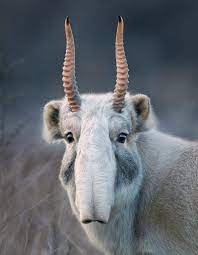
It is thrilling to know that their multifunctional nose enable them to produce the sounds that is similar to the sound of elephants. This is extremely crucial in the mating phase when the males are searching for the available females. Sometimes, they inform about their arability through the strong vocals but sometimes need to fight with other males to win the future mother of his babies. In the mating period, the males don’t waste time to eat so they are getting weak and risk to be prey for the steppe wolves that are following them , waiting for a meal. Nevertheless, this behaviour formula has another background and it is a kind of sacrifice for the coming generations. If the weak male is the victim of the wolves, they won’t hunt the pregnant female and the circle of life will be kept going.
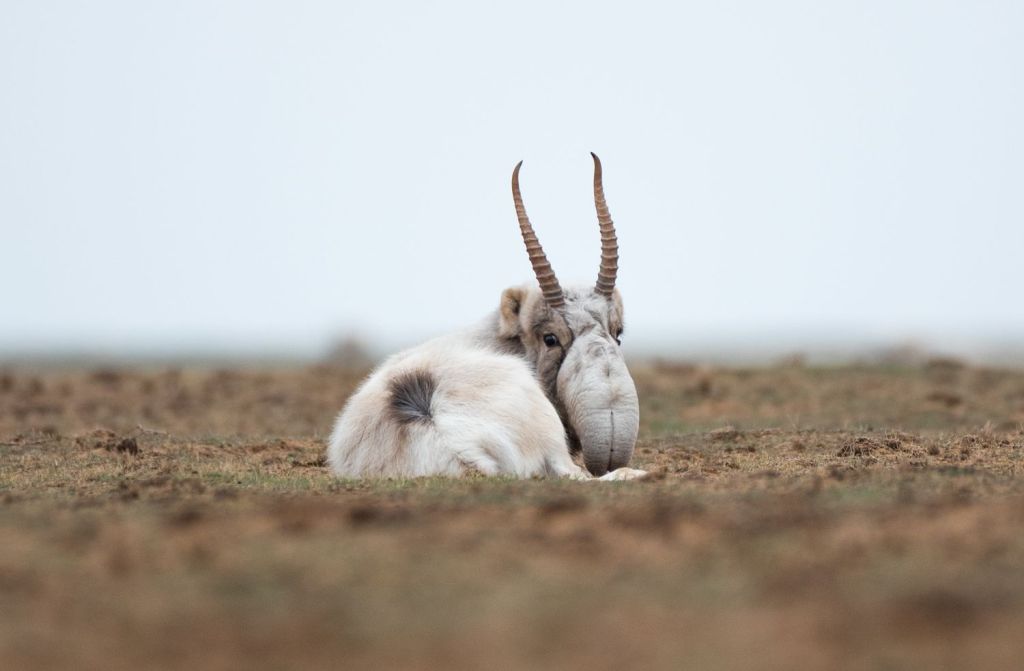
Those animals are vulnerable in the ecosystem but not only because of their natural predators, that they used to live with , but because of the humans who do not accept the borders. The constant and urge demand to ruin the natural habitats and to put many animals in the real dangers or under the risk of existence, shaped humans into the real disaster makers. No matter where they are, they bring the horror and tragedy, spitting the curse on the life and provoking the nature till the last breath. Nobody can tell me this is the profile of the homo sapiens, because there have been Homo sapiens, many centuries ago, and he was in the harmony with the nature. He hunted to eat and not for a sport activity. He killed to protect himself and not to have pleasure. The difference between that human and his human is big and scary. Who we are now and what is our mission ? We have been guardians of the Planet and all what we do now is ruining. We ruin the world around us and within us. We are deeply broken structures with no hope. It doesn’t surprise me when AI take over once, the civilisation we built and we will also destroy.
The saiga antelope need our support in the survival dance somewhere out there. They are born to be free and to run along the wind. We are born to protect them and many other animals that are our fellows. The Earth is planet for all of them, not reserved for humans only.


 SARAH MAX RESEARCH
Sarah’s intriguing and informative article reminded me of how specific mammals evolved after the last mass extinction of 66 million years ago…
The insects, plants and small mammals emerged from the ashes, and as the planet’s orbit altered sporadically, climate and topographies changed; propelling genetic alterations of adaptation in species.
The Saiga antelope species we know today first emerged about 1.5 million years ago, during The Pleistocene Epoch: they belong to the Bovidae genus (e.g. buffalo), which emerged about 20 million years ago in Africa, during The Miocene Epoch.
Over the past 2 million years, the planetary land surfaces and marine biomes have undergone definitive changes, which have driven biodiversity and unique evolutionary aspects like the Saiga antelope’s nostrils.
The Saiga would have begun with smaller features, but as they spread and began to inhabit and migrate to diverse topographies (e.g. arid areas, boreal forests and Eurasian steppes), their anatomical features adapted, accordingly… Their nostrils filter out dust particles in arid regions and help to cool the circulatory system during hot and dry vernal equinoxes. During winter, the nostrils function as a radiator; warming the oxygen before it enters the lungs. The nostrils have specialised-mucous membranes that arose from natural genetic modification.
With the present reality of global climate change, the Saiga antelope is capable of existing in some extreme situations, but its main threat is humans…
LikeLike
Wow got my interest never seen them before, I do not know how to reach you would you be interested in some work
LikeLike