

THE WILD CATS OF TOUGH MOUNTAINS

When I imagine the adorable snow leopard that is merging with snowy mountain regions, I cant be indifferent. That is one of the most beautiful wild cats that I have ever seen, at least on the photo, hoping to see it one day, in reality. Their majestic look, cold feature and mesmerising face is turning the rugged mountains into the fairy tale atmosphere. In spite of facts that they have never shown the aggressive behaviour towards humans, it is not recommended to approach this adorable mammal and to try any encountering since they are and remain wild animals.

I could never guess that this kind of leopard or Panthera uncia is more similar to tigers than to other members of leopard family and they are are almost extinct, with the number of individuals between 3,920 and 6,390 left in the wild. They have been categorised as leopard but they share more DNA background with tigers. Nevertheless, they are unique since they cant really roar like other big cats and they keep hissing, growling, chuffing and mewing. Those snowy beauties belong to Panthera genus together with lions, tigers, jaguars while cheetah and mountain lion or puma belong to the Puma genus. They all share the all other attributes of Felidae (feline) family.

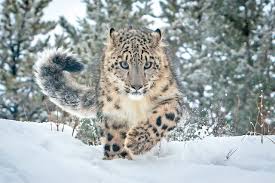
They are one of the smallest wild cats( 60-120 pounds or 27-55 kg) adapted to the frigid habitat and weather with no mercy. This means, they do have short legs and shot rounded ears so to be able to save the body heat. As many other animals that live in tough environment, they have wide nasal cavities to heat the air before it reaches the lungs. Talking about fur, they could be proud of their thick fur, up to 5 inches ( 12 cm) which enable them easy deal with snow and this also covers the paws. In other words, the sow leopards are naturally good snowshoeing athletes. Beside it, they have long tail, which is unusual for other wild cats, but that’s how nature found a solution for cold days and nights, so they can cover their sensitive parts or make a storage of the food in unlucky period of time. Their fur that is a perfect camouflage and colour balayage in harsh snow region is actually their way out from survival risks in the area that is considered to be wild, terrible and hard for existence. Those cats live in the parts of Rocky Mountains in Central Asia (including the Himalayas) and migrate, in the summer time, between 10,000 and 20,000 feet ( 3,000 and 6,000 m) but in the winter, they do the descending up to 4,000 feet (1,200 m). These attractive cats we can find only in one continent and that is Asia, but in 12 countries. The half of population is located in China and the rest in Afghanistan, Bhutan, India, Kazakhstan, Kyrgyzstan, Mongolia, Nepal, Pakistan, Russia, Tajikistan, and Uzbekistan.

The scientists believe that they can cover the range of 750,000 square miles which is approximately the size of Alaska and Texas together. One animal, itself, can have a range of 400 square miles. The snow leopard has no other enemies but humans. This put it on the top of food chain, giving the keyplayer role in keeping the ecosystem healthy and clean. They control the number of herbivores and also stop the habitat being ruined and causing further ecosystem challenges. Thats is the job of apex predators, no matter how that doesn’t look good or cute:“Snow Leopards are crepuscular, meaning that they are most active at dawn and dusk. They are opportunistic hunters, willing to adapt to whatever prey is available in abundance. They are the only species of big cat that will do this. That being said, the preferred Snow Leopard prey is typically large herbivores, such as Mountain Sheep, Ibexes, and Goats. These cats can take down animals three times their weight. When pressed, they’ll go for smaller creatures like Rabbits, Voles, and Marmots. They’ll even hunt birds in a pinch.”

The snow cats hunt alone or only sometimes, during the mating season, in pairs. As solitary and highly elusive, they make one big kill every few days and then do the food storage in the snow tunnels. The moms stay with their cubs up to 22 months, after the gestation period from 3- 4 months. Sometimes they have 5 babies but in standard there are only 2. It is interesting that little chubby babies even cant walk for 5 weeks, but after that time, they do develop themselves very quickly, starting with 3 months the life training with their mothers. In wild, they live from 10-15 years and in captivity, up to 20.
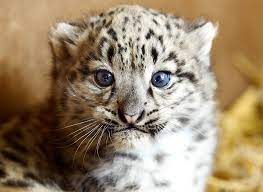
The great news recently is that they just removed from endangered list to the vulnerable list of IUCN. Their wild population is in decline but there are many actions that to be stopped. Their habitat is being destroyed for years and used for human purposes and cattle industry. This is naturally a basic reason for conflict between humans and those cats. Since their living environment is attacked by humans and their spreading, it causes that those animals don’t have enough prey themselves so they go into the villages and make a kill by farmers. That lead directly to the revengeful farmers that kill snowy leopards. Not to forget the issue with illegal wildlife trade and the manning of snowy leopards in Chinese medicine and the price of fur on the wildlife market. There are still hundreds of cats being killed for fur or bones, just for poaching interest as always. That is devastating fact especially because we all know what is going on in Asia.

The wildlife organisation try their best to ensure the wellbeing of snow leopards in the near future. The Snow Leopard Project that has been founded in 1998 by Shafqat Hussian in Pakistan is trying to compensate the loss of farmers, caused by snow cats, so they give up on killing of those beautiful mammals. Then, there is also The Snow Leopard Trust and the Snow Leopard Conservancy that work on educations of locals and motivate them to learn about those amazing ghosts of mountains, the proof that Nature makes the unique creatures of all times.


 SARAH MAX RESEARCH
Much loved. ??????
Sent via the Samsung Galaxy S22 5G, an AT&T 5G smartphone Get Outlook for Androidhttps://aka.ms/AAb9ysg ________________________________
LikeLike
Sarah’s delightful and informative article induced me to consider the environmental conditions that triggered the genetic divergence of the snow leopard from tigers, c. 3.5 million years ago…
Scientific data (e.g. geological, biochemical and palaeontological) reveals that the climate and topography of Central Asia were different from the present period, around 3.5 million years ago: average mean air temperature across the planet was 2.5°c warmer than now and ocean levels were 25 meters higher. The regional biodiversity of Central Asia was much more diverse and competition among species was definitive.
In all probability, groups of tigers began to colonise areas of higher latitudes in Central Asia, in order to decrease competitiveness and to predominate in specific biomes (i.e. along with other species like saber-toothed tigers [appeared 37 million years ago] and large Siberian cats). Higher latitudes would have required thicker fur and camouflage for hunting and for protection against lager predatory mammals.
Both the saber-toothed tiger and snow leopard developed spots, as opposed to stripes, which reflects the biome conditions (i.e. stripes in a jungle are better camouflage and spots in rocky and snowy areas are better for concealment, in general). The Siberian tiger species retained its stripes as it focused its predatory skills in forest areas (i.e. stripes mixed in with trees in the snow).
LikeLike